
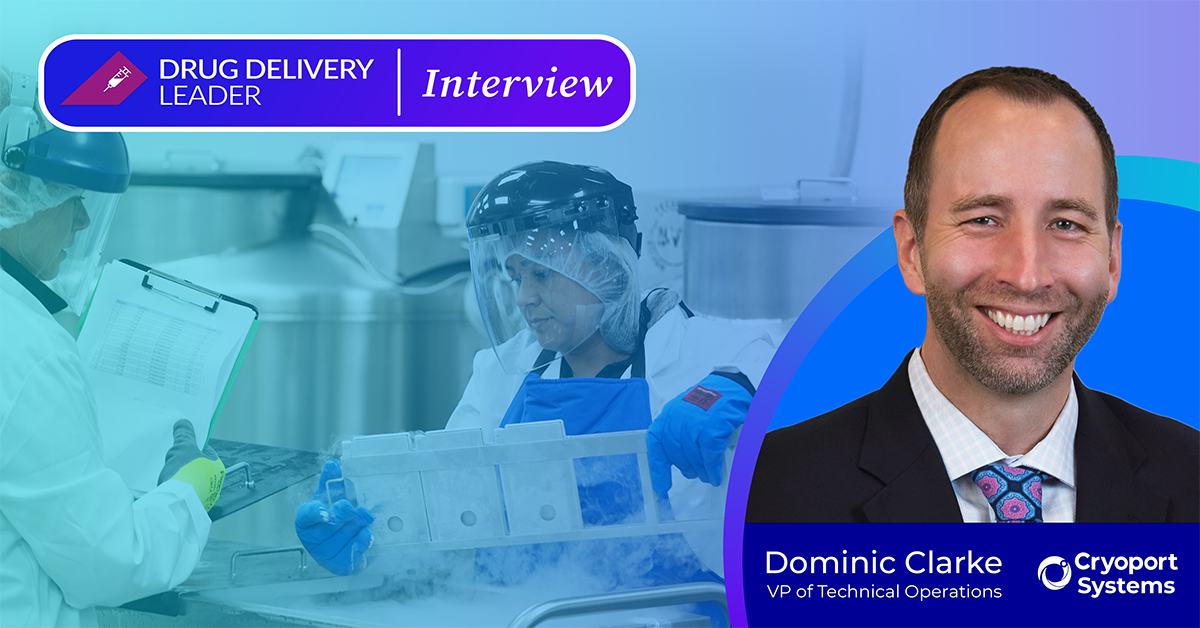
Building the Infrastructure to Enable Patient Access to Advanced Therapies: A Deep-Dive with Dominic Clarke, VP of Technical Operations
Advanced therapies have delivered some of the most significant medical breakthroughs of our time and fundamentally changed patient outcomes. The science is proven, but innovation alone doesn’t guarantee patient access.
Now, our challenge has shifted to manufacturability and scalability. Building the infrastructure for personalized cell-based therapies starts with standardized supply chain operations that can scale in a highly complex ecosystem.
In a recent interview with Drug Delivery Leader, Dominic Clarke, VP of Technical Operations at Cryoport Systems, dives into supply chain challenges, advances in technology, and how to build best-in-class processes for scalability, enabling life-changing therapies to reach the patients who need them.
From a Scientific Innovation to a Healthcare Delivery Challenge
For years, the advanced therapy industry’s primary focus was gathering evidence that supported the biology for cell-based therapies. Today, science answers those major questions: Can we engineer cells to eliminate cancer? Can we modify the immune system to treat diseases? According to Clarke, the proof is there.
Our focus has now shifted to manufacturing challenges for a process with a complex single patient journey. Clarke highlights CAR-T therapies as an example. He explains that unlike traditional pharmaceutical products that produce identical doses, autologous CAR-T therapies are uniquely manufactured for an individual patient.
The process begins with leukapheresis, where the patient’s immune cells are collected and transported to a manufacturing facility. At the manufacturing facility, the cells are genetically engineered to recognize and kill cancer cells. Those cells are expanded, tested for quality, and prepared to ship back to the patient’s treatment location. The patient undergoes additional conditioning therapy, which all needs to be coordinated before receiving the CAR-T therapy infusion.
Every step occurs under tightly controlled conditions and requires coordination across collection sites, manufacturers, logistics providers, and treatment centers. There is no room for errors, making infrastructure even more critical.
The Coordinated Systems Behind Advanced Therapies
Clarke emphasizes that we are not simply moving a drug through the supply chain. For advanced therapies, we are transporting living biological material. The patient becomes part of the manufacturing process itself, adding an additional layer of complexity. Supply chain processes have advanced to keep pace with the science.
Emergence of Real-Time Monitoring
The entire viability of the cell-based product relies on the enforcement of a proper Chain of Compliance®. Today, shipping systems have evolved far beyond simply maintaining temperature. Clarke explains the crucial role of real-time monitoring systems to provide visibility into temperature, location, orientation, vibration, and handling throughout transit. This level of traceability helps ensure living biological materials maintain their integrity while moving through a global network of stakeholders.
Growing Role of Cryopreservation
One of the challenges Clarke highlights is that patient material is often collected fresh and moved immediately into manufacturing, creating pressure throughout the process when delays occur. Cryopreservation technologies such as IntegriCell® help developers preserve the viability and quality of starting cell material while creating more flexibility across the advanced therapy ecosystem. This added flexibility is crucial when coordinating the complex process of personalized therapies against manufacturing capacity, logistics operations, and patient scheduling.
What’s Next for Advanced Therapy Supply Chain
Looking to the horizon, Clarke wrapped up the conversation, reinforcing that it’s an exciting time for the advanced therapy industry. Breakthroughs in gene editing, cell engineering, and in vivo therapies will dramatically expand the range of diseases that can be treated. On the operational side, he also highlighted the promise of automated facilities, greater digital integration, smarter monitoring systems, and decentralized treatment models to ultimately bring therapies closer to patients.
However, Clarke warned that patient access truly relies on the industry’s ability to build connected, scalable supply chain systems and establishing that type of infrastructure will not fall on a single organization. According to Clarke, we’re entering an era in the industry where collaboration becomes a competitive advantage.