Scaling Animal Health Programs Shouldn’t Mean Requalifying Your Supply Chain
Animal health programs tend to reveal their logistics weaknesses at the point of growth. A process that feels manageable when a therapy, vaccine, biologic, or reproductive material is moving between a limited number of familiar sites can become difficult to defend once the same program expands across facilities, regions, partners, or countries. The science may be ready to scale, but the operational framework often has to prove that it can scale with it.
That proof can become a source of friction. As programs grow, quality and regulatory teams are asked to confirm that each new site, lane, vendor, and process can meet the same expectations already established elsewhere in the network. If the supply chain depends on different SOPs by region, inconsistent documentation practices, or vendor-specific handling models, every expansion step creates another qualification burden. Teams may find themselves reviewing similar processes repeatedly because the underlying framework is not consistent enough to carry confidence from one location to the next.
For animal health pharma teams and advanced therapy developers, that burden can slow progress at precisely the moment the program needs momentum. Regional expansion, broader clinical activity, commercial readiness, or distributed veterinary delivery all require a logistics model that can maintain control without forcing the organization to start over each time the network changes. Scaling should make the program stronger and more reliable. It should not create a growing trail of exceptions that quality teams have to reconcile later.
The most effective way to reduce that friction is to build around standardization. Unified SOPs, validated systems, consistent equipment controls, and a global quality framework help animal health programs expand from a known foundation. When the same expectations govern how shipments are prepared, monitored, handled, documented, and reviewed, teams can focus on execution rather than repeatedly proving that each part of the network is operating to an acceptable standard.
Growth Puts Pressure on Local Workarounds
In the early stages of an animal health program, local knowledge can cover a lot of operational gaps. Teams may know which site has the most experience with a given material, which receiving location needs extra coordination, or which internal contact can resolve a documentation issue quickly. That familiarity can keep a small program moving, but it does not create a durable model for scale.
As more sites enter the network, informal knowledge begins to lose its value. A new region, for example, may have a different receiving process. Or a partner facility may document shipment conditions in a system that doesn’t align with records used elsewhere. These differences may emerge slowly at first, flying under the radar, but they quickly become harder to manage when shipment volume increases or a quality event requires a clear explanation of what happened.
The problem is not always visible in routine shipments. Materials may arrive on time, the basic paperwork may be complete, and day-to-day operations may appear stable. The weaknesses surface when a program needs to answer a more demanding question. Was the shipment handled according to the same controlled process used in other regions? Was the equipment qualified and requalified in a consistent way? Are the records strong enough to support an investigation or inspection? If the answer depends on which site or vendor handled the shipment, the program has a scalability issue.
Animal health supply chains are already operating in a more demanding environment than they were a few years ago. Vaccines, biologics, diagnostics, reproductive materials, and advanced therapies can carry strict temperature, timing, biosecurity, and handling requirements. As these products move through broader networks, variability becomes more than an inconvenience. It becomes a source of quality risk, or worse, regulatory uncertainty.
Requalification Becomes Painful When the Framework Is Fragmented
Requalification itself is not the problem. A controlled program needs evidence that equipment, procedures, and providers are suitable for the materials being moved. That discipline protects both the product and the organization. The difficulty begins when requalification becomes repetitive because the supply chain has been assembled from processes that do not align.
A team may qualify one vendor for a particular region, then repeat a similar exercise when another region uses a different provider. A shipping system may be accepted in one lane, but require new review elsewhere because the equipment history, maintenance records, or qualification practices are not managed under the same framework. A new site may be operationally ready, yet delayed while quality teams compare its procedures against procedures already approved in another part of the network.
That kind of work consumes time without necessarily improving control. It can also create a false sense of progress, where each individual review is completed but the broader operating model remains difficult to scale. The organization keeps solving the same problem in new locations because the process was never standardized at the network level.
A stronger approach is to reduce the number of variables that need to be re-evaluated each time the program grows. When SOPs, shipping systems, monitoring expectations, documentation standards, and requalification practices are unified, new sites can be brought into a framework that is already designed for consistency. Quality oversight remains essential, but the starting point is stronger because the process does not have to be interpreted from scratch.
Regulatory Confidence Comes From Repeatable Control
Animal health logistics are moving toward higher expectations for traceability, and process control. While regulatory requirements vary by product type, region, and application, the general direction is clear. Sensitive animal health materials are being handled with a level of discipline that increasingly resembles human biopharma logistics, especially as advanced therapies and complex biologics become more common.
That shift places pressure on organizations to show that their supply chain is controlled across the full network. A successful delivery is no longer enough to establish confidence. Teams need to demonstrate that the materials were protected during transit, that the equipment performed as intended, and that the (audit-ready) records can support quality decisions if questions arise.
Inconsistent processes make that harder. If one region monitors shipments differently, another relies on a different requalification practice, and a third produces records in a format that must be interpreted separately, the organization may struggle to present the supply chain as a unified quality system. That weakens confidence even when individual shipments appear to have been managed properly.
Repeatability is what strengthens the position. A program that can show consistent procedures, validated systems, controlled equipment management, and standardized documentation has a clearer story to tell. It can demonstrate that growth is happening within a quality framework rather than around one. That distinction matters for animal health teams preparing for broader commercialization, regional expansion, or increased regulatory scrutiny.
Cryoport Systems Reduces Variability Before It Becomes a Scaling Problem
Cryoport Systems supports animal health programs through a global quality framework built for consistency. This approach is designed to remove many of the variables that typically create requalification headaches as programs grow. Unified global SOPs, ISO 21973-certified processes, validated shipping systems, Veri-Clean® validated cleaning, and 100% shipping system requalification work together within the Chain of Compliance® to create a controlled foundation that can support expansion without forcing teams to rebuild confidence at every new step.
The impact is especially important for programs moving beyond a single facility or region. With alignment across the full global footprint, teams are not left comparing local procedures to determine whether each site is operating to an equivalent standard. The process is designed to be consistent from the start.
ISO 21973-certified processes add another layer of rigor. Although the standard was developed for the transport of human cells for therapeutic use, its principles are highly relevant to animal health programs moving sensitive biologics, regenerative therapies, vaccines, and other high-value materials. Environmental control, traceability, equipment validation, and communication protocols are all central to maintaining confidence as programs expand.
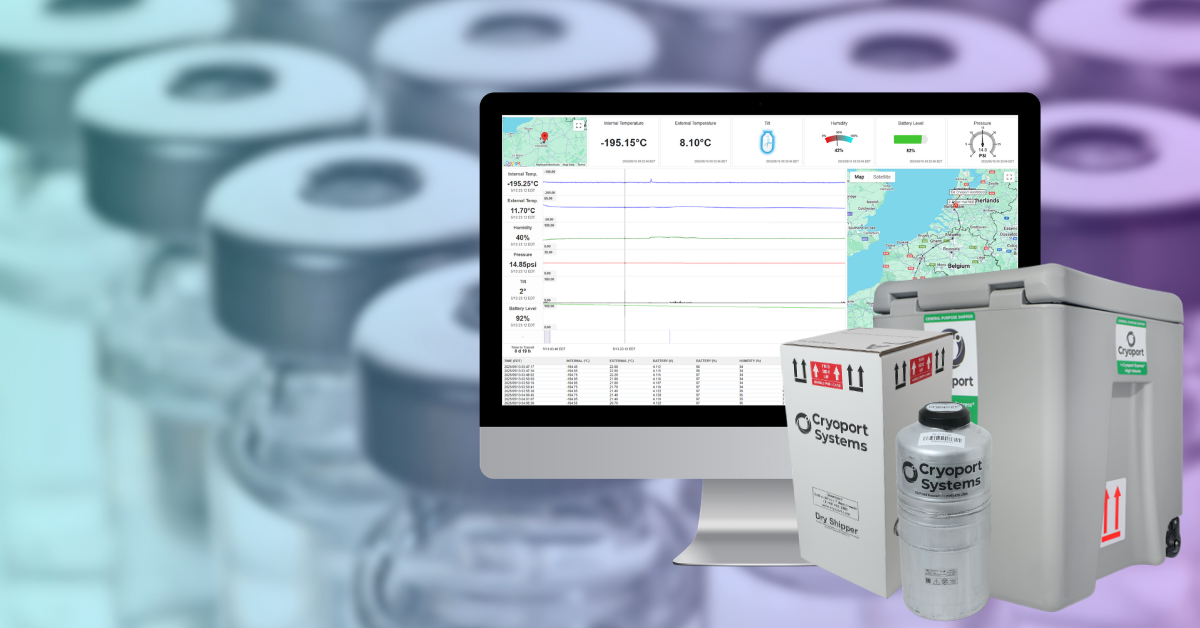
Validated shipping systems help ensure that the equipment protecting each shipment is suited to the intended use. Cryoport Systems reinforces that control through 100% shipping system requalification before every use, which helps verify that systems are ready to perform before they return to service. That consistency reduces uncertainty across lanes and regions because equipment readiness is built into the process rather than treated as an assumption.
Veri-Clean® supports biosecurity through a validated decontamination process applied to shipping systems. For animal health programs, where materials may move between production environments, clinics, livestock settings, research facilities, and international lanes, that level of control can be critical. Biosecurity cannot depend on inconsistent local practices when the program is growing. It has to be embedded into the operating model.
Together, these controls help animal health organizations avoid the cycle of vendor-by-vendor and site-by-site requalification. The goal is not to eliminate quality review. The goal is to make quality review more efficient and more defensible by reducing variability at the source.
Scaling Without Starting Over
A supply chain built for scale should become easier to manage as the program matures. Each new site should fit into a controlled framework. Each new region should operate under the same quality expectations. Each increase in volume should be supported by systems that have already been validated, documented, and requalified through a consistent process.
When that foundation is missing, growth tends to expose the weaknesses that earlier phases could absorb. Animal health teams can avoid that pattern by standardizing before variability becomes embedded.
Cryoport Systems brings those elements together for animal health programs that need to scale without losing control of their supply chain. With unified global SOPs, ISO 21973-certified processes, validated shipping systems, Veri-Clean®, 100% shipping system requalification, and integrated traceability through Chain of Compliance®, Cryoport Systems helps teams expand with fewer requalification burdens and greater confidence in shipment integrity.
Growth should not require animal health organizations to re-prove the same controls every time the network changes. When quality is built into a standardized global framework, expansion becomes more predictable, compliance becomes easier to defend, and teams can move into new sites and regions without carrying avoidable requalification challenges forward.