
How Operational Efficiency Shapes Late-Phase Manufacturability
For many advanced therapy programs, there’s a moment when the program looks like it should be able to scale cleanly, and it just… doesn’t. Not in an obvious way that can be recognized and addressed in the moment, but in the introduction of small measures of friction when the schedule doesn’t align the way it was intended to, or where time is introduced in places where it shouldn’t be.
These aren’t major disruptions. They’re small enough that they don’t even register as a pattern at first. Teams simply work through them (rather than addressing the root causes), making small in-the-moment adjustments and continuing toward the next milestone. But over time, that layer of adjustment stops being occasional and starts to become part of how the program operates. And before you know it, more time is being spent lining things up and course-correcting than actually running against a stable plan.
That’s where it starts to matter. Because at that point, manufacturability isn’t being defined by what the operational process can do under tightly controlled conditions. Now, it’s being defined by how consistently you can deliver into it.
The Limits of Fresh Leukapheresis at Late-Phase
One early point of friction that becomes more visible at this stage is how much of the variability teams encounter is driven the starting material itself.
For many programs, fresh leukapheresis-derived starting material remains the default. Early on, it offers an intuitive and familiar path from collection into manufacturing. But it also compresses the entire workflow into a narrow, time-sensitive window that becomes increasingly difficult to maintain as programs expand. Collection, packaging, transport, intake, and initial processing all have to align perfectly within a defined timeframe (often under 48-72 hours), with very little room for deviation.
At a smaller scale, that compression is manageable. Schedules can be tightly coordinated when you’re working with a single collection site, a single manufacturing site, and a well-known and well–characterized shipping lane between the two. As the number of collections increases and sites expand across regions, that same model begins to introduce friction when shipping lane timing becomes variable, or differences in collection timing begins to affect how seamlessly material can move into manufacturing.
The end-to-end supply chain relies on close coordination between collection and manufacturing, and how materials move from one step to the next. That synchronization becomes more challenging to maintain as programs grow into later-stage clinical trials with expanded patient populations and a growing network of sites. As this happens, the increasing complexity of the shipping lanes and coordination of material movement starts to carry variability further into the workflow than it did in the early stages.
When Upstream Timing Starts to Dictate Throughput
Where this starts to have a downstream impact is in how reliably manufacturing can operate against its own plan. When everything upstream is tied to a tightly compressed timeline, even small shifts in when the starting material is collected or received will influence how the manufacturing schedule actually unfolds. And, over time, that begins to affect how capacity is used and how efficiently teams can plan against a defined schedule. What looks like available capacity on paper becomes harder to capture in practice, because the inputs required to use that capacity aren’t arriving in a way that allows for the predictability and structure that reserved manufacturing slots require.
This isn’t something that impacts operational workflows when programs are in the early stages and working with low volumes. It surfaces later, when programs are trying to increase throughput. On its own, manufacturing may very well be capable of supporting more volume. But when the inputs feeding into it aren’t consistently aligned, increasing throughput becomes less about scaling output and more about managing around the variability that has become part of the supply chain.
Changing the Conditions Manufacturing Has to Operate Within
There’s a different approach to the supply chain that can change how this flows, but it requires an intentional shift in the conditions it’s built around.
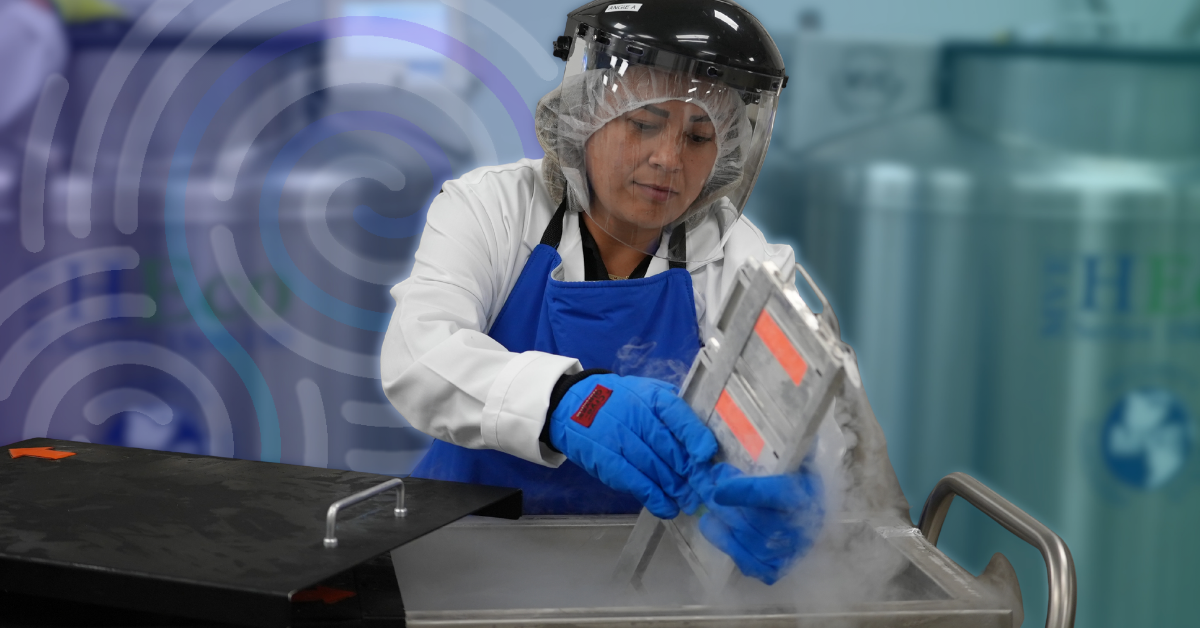
When starting material is no longer tied to a narrow manufacturing window, that dependency between collection and manufacturing begins to allow for more flexibility. Instead of needing to align collection and manufacturing within a tight timeframe, the leukapheresis-derived starting material can be cryopreserved and placed into secure biostorage, ready for just-in-time delivery to manufacturing. Planning shifts from coordinating around timing constraints to working against a stable input.
That change may be subtle in isolation, but it has a cascading effect downstream. When scheduling becomes more reliable because it’s no longer anchored to variability in collection and transport timing, starting material can enter manufacturing in a more consistent state (both biologically and operationally in how it’s handled and delivered). The supply chain no longer has to absorb the same level of ad hoc adjustment just to stay on track.
Stability Doesn’t End with Cryopreservation
But that kind of stability doesn’t come from one change alone. Because once you remove the time pressure on starting material, the next set of variables becomes more visible… how material is packaged, how it moves across shipping lanes, how consistently it’s handled from one link in the supply chain to the next, and how all of those elements are both documented and controlled.
Removing the narrow execution window around fresh starting material creates more flexibility in the timing between collection and manufacturing, but it doesn’t automatically create consistency across the rest of the supply chain. If packaging hasn’t been validated for how material actually moves across specific shipping lanes, if collection, and manufacturing kits are still assembled in different ways across sites, or if the supporting data and documentation has to be reconciled across multiple vendors and systems before material can move forward, the supply chain is still carrying more variability than manufacturing was built to absorb.
And that matters. Because once programs reach the stage where throughput increases and resource allocation needs to behave predictably, those surrounding conditions are no longer secondary operational details, or things that you can simply worry about later. They begin to shape how reproducible the manufacturing environment actually is. For example, if a packaging system performs differently from one shipping lane to the next, or a lane hasn’t been qualified under the conditions it will actually encounter, avoidable execution risk is layered into the supply chain.
Why Integrated Services Matter More at Scale
Cryoport Systems addresses these vulnerabilities through an integrated supply chain platform approach that brings cryopreservation, BioServices like standardized kitting, secondary packaging, and biostorage, lane qualification and packaging performance qualification, logistics, and audit-ready documentation all into one operational framework within a single-vendor partnership. This reduces both operational variability and reconciliation across handoffs.
When starting material is cryopreserved under an automated, closed process within a GMP-aligned workflow, supported by standardized BioServices, co-located with secure biostorage and onsite logistics (including the world’s largest, wholly-owned fleet of shipping systems), and then all of that is further supported with integrated shipping risk assessments, shipping lane qualifications, and shipping system and packaging performance qualifications that offer documented performance to support your regulatory filings, manufacturing is no longer operating downstream of a loosely connected set of activities. Within an integrated supply chain platform, manufacturing starts operating within a standardized workflow that was designed to deliver into it more consistently from the start.
Manufacturability Depends on More Than the Process Itself
By the time programs are increasing throughput and expanding across sites in preparation for what comes next, manufacturability is being shaped upstream. It’s being shaped by factors like whether starting material can be stabilized early, and whether movement through the supply chain is controlled and repeatable. It’s being shaped by whether the operational workflow has been intentionally structured to reduce variability instead of managing around it.
That’s where an integrated supply chain platform approach, like the one Cryoport Systems offers, changes the equation. By bringing cryopreservation, biostorage, kit production, logistics, packaging performance qualification, shipping lane qualification, and audit-ready documentation into a single, coordinated supply chain model, Cryoport Systems helps create the conditions for more predictable scheduling and a manufacturing environment that is easier to scale.
For programs moving through late-phase development, operational efficiency quickly becomes a primary (rather than secondary) consideration. It becomes a core function of how manufacturability is built and how readiness for commercial scale begins to take shape.