Continuing the Conversation: What Quality Leaders Need to Know About Building Supply Chains for Advanced Therapies
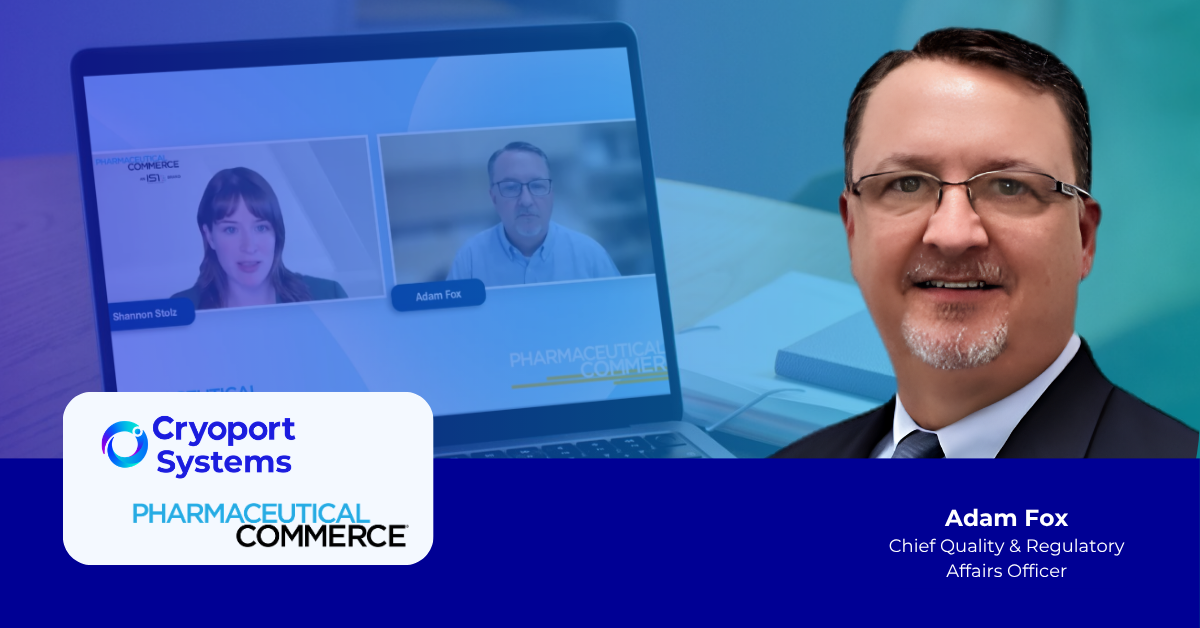
Following Pharmaceutical Commerce’s podcast with Adam Fox, Chief Quality & Regulatory Affairs Officer at Cryoport Systems, we wanted to explore several topics that deserve a deeper look. As cell and gene therapies continue to advance, quality leaders are discovering that supply chains have become an extension of the quality system itself.
Q&A With Adam Fox
Q: During the interview, you described how traditional pharmaceutical supply chains were not built for cell and gene therapies. What makes these therapies so different?
Across our business, we handle high-value materials, but the biggest difference now is that we are dealing with irreplaceable materials. In many cases, a shipment represents a patient’s own cells. There is no backup inventory sitting on a shelf.
That reality changes everything. Quality is no longer confined to the manufacturing process. It extends across collection, storage, transportation, processing, and delivery back to the patient. Every handoff matters, and every step needs to be controlled.
With traditional pharmaceutical products, a delay can be frustrating and expensive. With cell and gene therapies, a delay can directly affect a patient’s treatment journey.
Q: You often talk about supply chains as quality systems. What does that mean in practice?
A quality system is designed to create consistency, visibility, and control. Those same principles should apply to the supply chain.
For advanced therapies, it’s not enough to know a shipment’s location. You need assurance that conditions have been maintained throughout the entire journey. You need documentation that supports compliance requirements. You need processes that can withstand audits and inspections.
When organizations view the supply chain as part of the quality system rather than as a separate operational function, they tend to make better long-term decisions.
Q: What role does visibility play in protecting product integrity?
Visibility is one of the most powerful risk management tools available today. If you don’t have real-time insight into what’s happening, you’re often left reacting after a problem has already occurred. Modern monitoring technologies allow organizations to see conditions throughout the shipment journey and respond quickly when something unexpected happens.
Just as important, visibility creates confidence. Clinical teams, manufacturing teams, and quality teams can make informed decisions based on facts instead of assumptions.
Q: Many companies focus on shipping solutions. Are they overlooking other parts of the supply chain?
Sometimes they are.
Shipping is critically important, but it’s only one part of a much larger process. The supporting infrastructure behind the shipment often has an enormous impact on outcomes. Storage conditions, facility readiness, standardized operating procedures, trained personnel, contingency planning, and data management all contribute to success. If any of those elements is weak, it can pose a risk to the entire program. The strongest supply chains are built around the entire workflow.
Q: How should organizations approach risk as therapies move closer to commercialization?
Risk management should evolve alongside program maturity. What works for a small early-phase study may not be sufficient when manufacturing volumes grow, additional countries are added, and patient demand increases.
Organizations benefit from continuously evaluating their processes and asking difficult questions. What happens if a lane becomes unavailable? What happens if a site experiences an unexpected disruption? What happens if demand grows faster than anticipated?
Programs that perform these assessments early are often better prepared when growth accelerates.
Q: What is one mistake companies commonly make when planning for future growth?
Expanding upon the risk-based approach, many organizations assume that a process that works today will automatically work tomorrow. Commercialization introduces new variables (so again, more patients, more treatment centers, more manufacturing activity, and more geographies), and these all increase complexity.
Successful organizations routinely challenge what they “know” to be true. They test systems early and build contingency plans before a disruption occurs. Most importantly, they understand that resiliency must be built into the supply chain from the beginning.
Q: If you had one piece of advice for quality and supply chain leaders, what would it be?
Start earlier than you think. The most successful programs don’t wait until commercialization to think about quality systems, infrastructure, or risk management. They begin building those foundations during development and continue strengthening them as the program grows.
The therapies may be cutting-edge, but the underlying principle is simple. The more predictable and controlled your supply chain becomes, the more confidently you can deliver therapies to the patients who need them.
Final Thoughts
Advanced therapies are changing the future of medicine, but they also demand a new approach to quality and supply chain management. As regulatory expectations continue to evolve and commercialization efforts expand globally, organizations are recognizing that resilience is creating an end-to-end system that protects product integrity, supports compliance, and ultimately safeguards patient outcomes.
That shift from viewing the supply chain as an operational necessity to treating it as a quality system may be one of the most important transformations happening in the advanced therapy industry today.