Dominic Clarke on Reducing Variability Before it Becomes a Problem
As cell therapy programs advance, the pressure on supply chains doesn’t usually come from a single breaking point. It builds gradually, often in ways that aren’t immediately visible during early development.
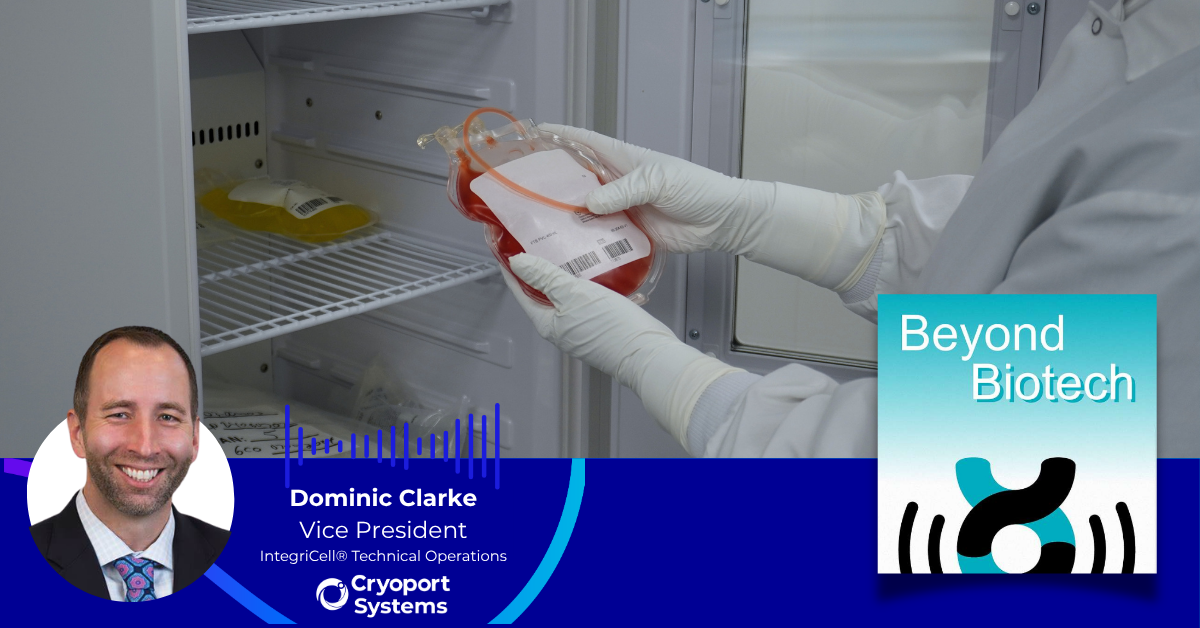
In a recent episode of Beyond Biotech, the podcast from Labiotech, Dominic Clarke, Vice President of IntegriCell® Technical Operations at Cryoport Systems, shares what that progression looks like.
Dominic focuses on where variability enters the supply chain, and how some of it is inherent to the therapy, but much of it comes from how workflows are structured. This is especially true when time-sensitive processes force decisions into narrow windows. When every step depends on what happened just before it, even small disruptions tend to carry forward.
This is where the conversation around cryopreservation is especially critical to the scalability of cell therapies. Decoupling collections from manufacturing introduces flexibility and gives teams more room to plan instead of always reacting in the moment.
Early decisions are more than technical. They shape how the supply chain performs as programs move toward commercialization. Workflows that rely on constant, time-critical coordination can still function, but they become harder to scale with confidence. Supply chains designed to absorb variability, on the other hand, tend to hold together more predictably over time.
Listen to the full episode here:
Freeze variability, not progress: strengthen your cell therapy supply chain from the start