
Articles Archives

Articles
08/28/2026
Continuing the Conversation: What Quality Leaders Need to Know About Building Supply Chains for Advanced Therapies
Following Pharmaceutical Commerce’s podcast with Adam Fox, Chief Quality & Regulatory Affairs Officer at Cryoport Systems, we wanted to explore several topics that deserve a deeper look. As cell and gene therapies continue to advance, quality leaders are discovering that supply chains have become an extension of the quality system itself.
Articles
08/18/2026
Beyond Clinical Success: Bianca Gustafson on Building Supply Chains That Scale
In a recent Contract Pharma interview, Bianca Gustafson, Senior Director of Program Management at Cryoport Systems, shared an important perspective on the transition from clinical development to commercialization. According to Gustafson, a common mistake organizations make is assuming that commercial readiness is an extension of clinical operations, when actually commercialization requires a full-on shift in how supply chains are designed and scaled.
Articles
06/24/2026
Now Available On Demand: Preventing Advanced Therapy Program Delays with Early Supply Chain Strategy
Advanced therapy programs move through development under intense pressure. Teams are working to reach the clinic, generate data, satisfy regulatory expectations, scale operations, and ultimately deliver therapies to patients who may have limited or no other options. In that environment of competing priorities, all of which are important at the same time, supply chain decisions can become easy to defer. But as a recent roundtable webinar with XTalks made clear, decisions around cryopreservation, logistics, packaging qualification, site readiness, and documentation are not just operational details that can be solved later.
Articles
06/24/2026
New eBook: Flexible Infrastructure for Smarter Scale in Advanced Therapies
Advanced therapy developers are being asked to do more with less. Programs need to move faster, reach more patients, support more geographies, and stay ready for evolving regulatory expectations, all while capital remains tightly managed. Cryoport Systems’ new eBook, Flexible Infrastructure: Minimizing CapEx for Smarter Scale in Advanced Therapies, explores that question across the advanced therapy lifecycle. The eBook looks at how developers can preserve capital, reduce operational risk, and avoid overbuilding fixed infrastructure before their programs are ready to use it.
Articles
06/22/2026
Mark Sawicki Joins Base to Base Biotech to Discuss the Future of Cell and Gene Therapy Logistics
Mark Sawicki, President and CEO of Cryoport Systems, recently joined host Jim Cornall on the Base to Base Biotech podcast for a wide-ranging conversation on the evolving cell and gene therapy landscape and the role of specialized supply chain infrastructure in supporting patient access.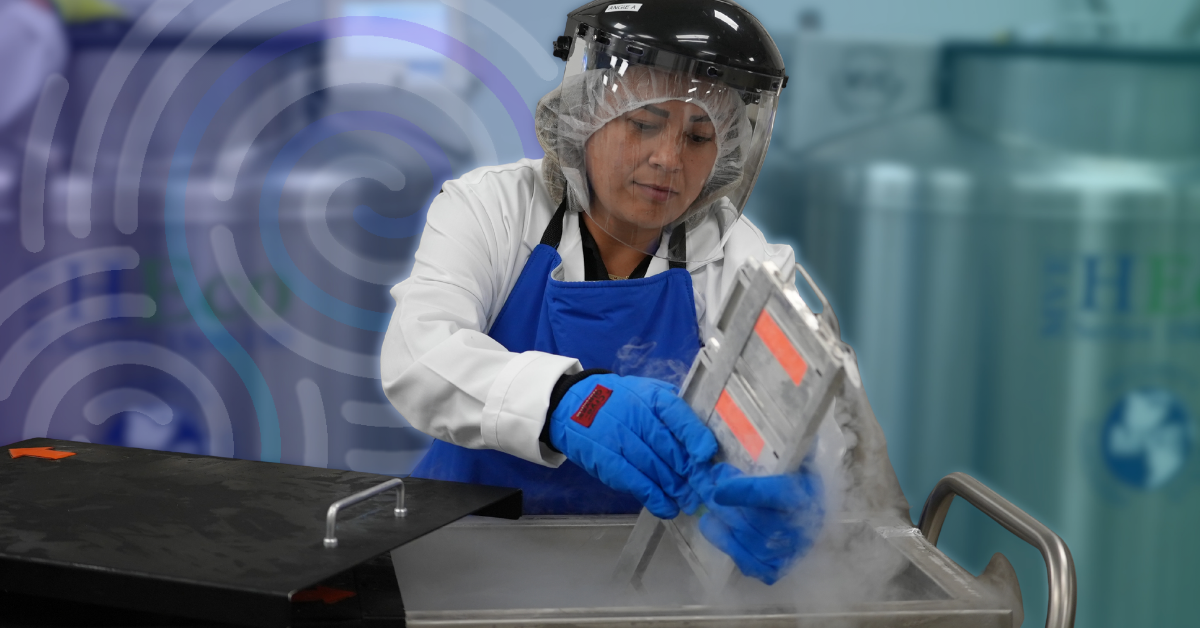
Managing the Cold Chain
06/09/2026
How Operational Efficiency Shapes Late-Phase Manufacturability
For many advanced therapy programs, there’s a moment when the program looks like it should be able to scale cleanly, and it just... doesn’t. Not in an obvious way that can be recognized and addressed in the moment, but in the introduction of small measures of friction when the schedule doesn’t align the way it was intended to, or where time is introduced in places where it shouldn’t be.
Articles
05/26/2026
Dominic Clarke on Reducing Variability Before it Becomes a Problem
As cell therapy programs advance, the pressure on supply chains doesn’t usually come from a single breaking point. It builds gradually, often in ways that aren’t immediately visible during early development. In a recent episode of Beyond Biotech, the podcast from Labiotech, Dominic Clarke, Vice President of IntegriCell® Technical Operations at Cryoport Systems, shares what that progression looks like.
Articles
05/26/2026
Cryoport Systems in Labiotech on Where CGT Supply Chains Start to Break
As more cell and gene therapy programs push toward later-stage trials and commercialization, a familiar set of pressures is starting to surface. What once felt manageable at smaller scale begins to take more effort to hold together as volumes pick up. A recent article in Labiotech, developed in collaboration with Cryoport Systems, looks closely at where that strain comes from and how it often traces back to decisions made much earlier in development.
Managing the Cold Chain
04/21/2026